
Modern Iran / An architectural study
5 million rials.Printed in detail.
Explore the mosque façade, the mausoleum and the fine details of Iran’s five-million-rial Iran Cheque.
Explore both sides →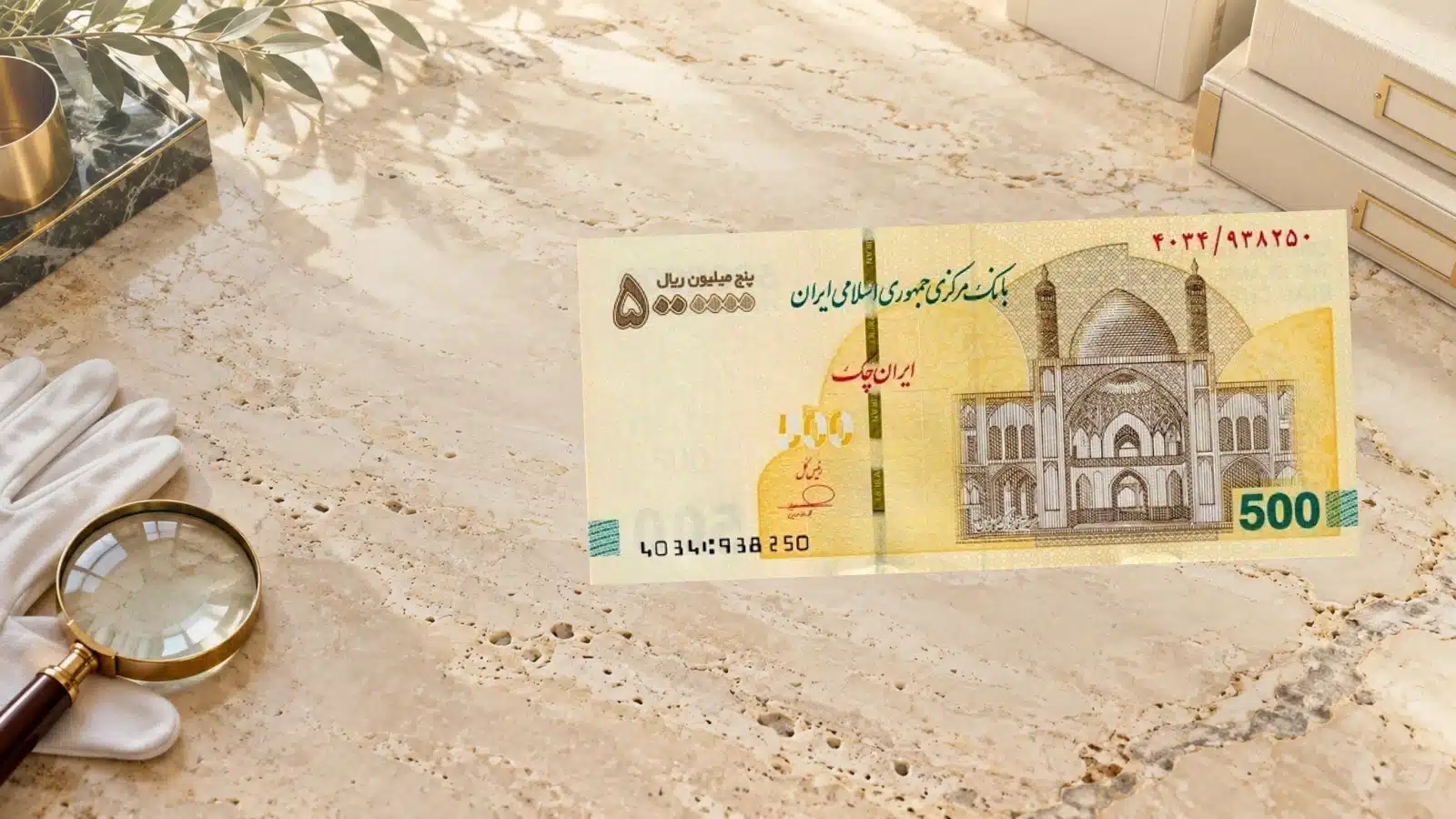
The appeal begins with architecture. The collector’s record begins with the exact note.
01 / Read the design
Two sides of one architectural story.
The Iran 5 million rials banknote brings together a mosque façade on the front and a stepped mausoleum on the reverse. Our product listing identifies these as Agha Bozorg Mosque in Kashan and the Mausoleum of Ferdowsi in Tus. The photographs below let you compare the actual artwork, lettering and color balance rather than relying on a small shop thumbnail.
The front combines warm yellow tones, a prominent architectural entrance and Persian inscriptions. On the reverse, the English inscription identifies the Central Bank of the Islamic Republic of Iran and the instrument as an Iran Cheque. The words “FIVE MILLION RIALS” and the numeral 5000000 provide a useful denomination cross-check.


02 / Identify before cataloging
A denomination is only the first line.
Start your collection record with the issuing authority, instrument type and full denomination. Then add the design, printed date where present, signatures, serial prefix and a catalog reference verified against that exact variety. Two examples with the same face value do not automatically belong to the same printing.
The shop description
Our listing offers the note as a 2026 UNC example and uses the catalog reference W168. Check the live listing for the precise item supplied.
Your collection record
Keep photographs of the actual example and verify the catalog attribution independently. A seller’s image filename is not proof of an issue date.
The large 500 numeral and the full 5,000,000-rial denomination appear together in these photographs. Record what the note actually says. Do not derive a current exchange value or a universal rial-to-toman conversion from that shortened numeral.
03 / Examine the physical note
Turn a photograph into a useful inspection.
A front photograph can show the position of a vertical strip, fine printed patterns and a reflective area. It cannot establish how a watermark, thread or optical element responds under examination. Visible artwork and a tested security effect are different kinds of evidence.
- In normal light: compare the fine lines, lettering, serial printing and overall layout with a reference for the exact issue.
- In transmitted light: ask for a backlit image and compare only those watermark and thread features documented for that issue.
- While tilting: request a short unfiltered video of any documented angle-dependent feature. A still image cannot show a color change or moving effect.
- With suitable equipment: compare documented UV responses and magnified detail. Do not treat one glow or one shiny area as a complete authentication result.
Keep the banknote unchanged.
Inspect gently. Do not scrape, wet, fold or rub a feature to “test” it. These photographs are ordinary product images, not backlit or UV security plates. If the required examination evidence is missing, request it before making a firm authenticity judgment.
04 / Build a denomination pair
Five million beside ten million.
A denomination pair is a useful small collecting project: it is focused enough to complete, while offering room to compare architectural artwork, color, inscriptions and layout. Begin with the five-million-rial note and use our Iran 10 million rials guide to examine the next denomination separately.
| Compare | What to record |
|---|---|
| Denomination | Full value in numerals and words on each note. |
| Artwork | The front and reverse buildings, verified for each issue. |
| Attribution | Date, signatures and catalog reference for each actual example. |
| Condition | Folds, corners, stains and any disclosed handling. |
Choose the pair because it fits your collection, rather than assuming that a larger printed denomination means a rarer or more valuable collectible.
05 / Choose your example
What to check before buying UNC.
UNC is a condition description, not an issue date or a stand-alone authenticity certificate. Ask whether the listing photographs show the actual note or a representative example, whether the year and signature may vary, and whether a specific serial can be requested. Inspect both faces and the edges for folds, corner wear, stains or surface changes.
Read the banknote grading guide if you are comparing condition terms. Then use the five-million-rial product page for current availability, the item description and purchase terms. Keep the invoice and the supplied description with your record.
For a broader denomination project, browse the Iran banknote collection. Add only the values and varieties that suit your chosen scope; there is no need to buy a full series before learning how to identify one example well.
06 / Collector questions
Details worth checking twice.
Is this a banknote or an Iran Cheque?
The photographed reverse explicitly reads “IRAN CHEQUE”. Collectors often search for it as a banknote; record the instrument’s own wording as well as the denomination.
Does the large 500 mean the value is only 500 rials?
The same reverse prints “5000000” and “FIVE MILLION RIALS”. Use the complete inscription to record the denomination rather than reading the large shortened numeral on its own.
Will I receive the photographed serial number?
Check the individual listing and ask before ordering. A representative product photograph does not promise the same serial, prefix or signature.
Does UNC mean independently certified?
No. A raw note described as UNC is not automatically encapsulated or graded by an independent grading company. Read the product description for exactly what is included.
Sources & image notes
The design observations above come from the original front and reverse photographs shown here. Product year, condition and W168 attribution are identified as listing information rather than independent catalog verification. Refer to the exact product listing and a current specialist catalog for the example you choose.
Editorial review: 21 October 2026 · Collectible Money. Original currency images; no generated or redrawn banknotes.