
In the collector’s library
50,000 dinars.Beyond the number.
A marshland scene, a secure window and the details that distinguish your exact note.
Discover the window →Large numerals draw the eye. The artwork, issue details and physical features reward the closer look.
01 / Landscape and daily life
Read the note from front to back.
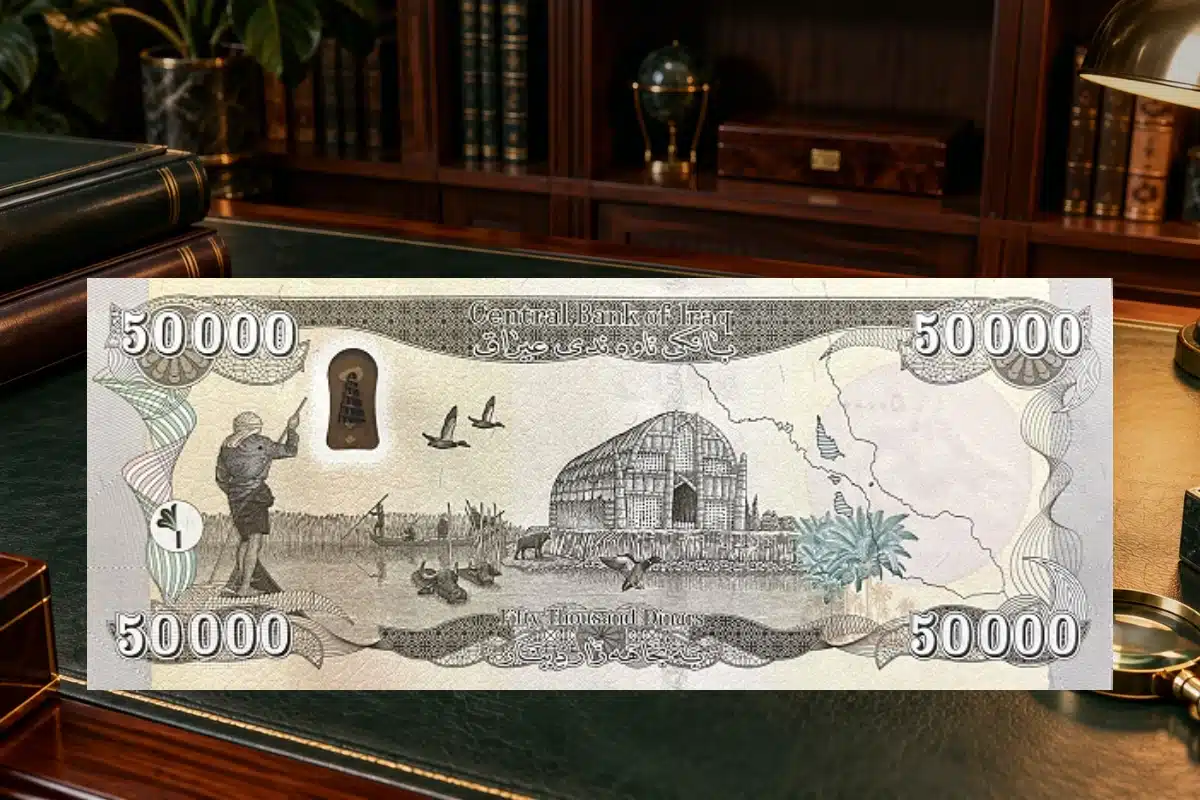
The 50000 Iraqi dinar banknote is a distinctive subject for a modern Iraq collection. Its front combines palms, a waterwheel, a decorated vessel and landscape imagery; the reverse brings together marshland life, a reed structure, birds and a map. Seen as a pair, the two faces offer far more to collect than the denomination alone.
The Central Bank of Iraq includes the denomination among its circulating-banknote illustrations and records its introduction in 2015. That introduction date is the starting point for the denomination’s history, not an instruction to label every later printing “2015”. Identify the actual example separately.

Obverse / Water and landscape
Follow the front.
Start with the waterwheel, palms and printed details. Keep the date, governor information and serial with your collection record.

Reverse / Life in the marshes
Turn the story over.
The reed structure and map give the reverse its identity. Compare the minaret window from both sides under suitable light.
02 / Attribute the actual note
Denomination, issue and variety.
A useful record separates four questions: what is the denomination, which issue or printing is it, which catalog entry describes it, and what is the condition of this particular example? A broad shop date range can be convenient for stock management, but it is not a precise identification of every note in that range.
| Record | Check on your example |
|---|---|
| Face value | 50,000 dinars; compare the denomination in words and numerals. |
| Issue details | Printed date, signature or governor name, and any documented design changes. |
| Catalog entry | Match the actual variety to a current reference; do not infer a Pick number from value alone. |
| Individual note | Serial, prefix, condition and photographs of both faces. |
Our 50,000-dinar product listing describes the stock offered as UNC within a 2020–2025 range and uses Pick 103. Use that as the seller’s description, then confirm any exact year or variety requirement before ordering. A representative image does not promise the illustrated serial number.
03 / Examine with light
A window within a paper banknote.
The minaret motif is one of the most interesting details to examine. For the 50,000-dinar note dated 2015, Regula documents a varifeye secure window made with transparent film in a paper note. Its spiral-minaret image changes appearance between transmitted light, oblique light and a dark background. This is a documented example; compare later varieties with the appropriate reference rather than assuming every printing is identical.
Look through.
Hold the note toward a light source and inspect the window from both sides. Compare the motif, its position and the surrounding printed design with the correct issue.
Change the view.
Examine the feature in reflected and oblique light and against light and dark backgrounds. Request an unfiltered video if you cannot inspect the note in hand.
Louisenthal explains that varifeye windows can be embedded in paper. The presence of a transparent film feature therefore does not mean the whole note is a fully polymer banknote. The window is also distinct from a watermark and a narrow security thread.
Observe the effect, not just the outline.
The full reverse photograph above shows where the window sits, but an ordinary still photograph cannot demonstrate its changing optical behavior. Use more than one examination method. Our Iraqi dinar authentication guide explains watermark, thread, window and print checks together.
Handle the note gently throughout. Do not scratch, wet or rub a feature to test it. If a detail appears inconsistent, first establish that you are comparing the right issue, then seek an experienced specialist’s in-hand assessment when needed.
04 / A separate question
Choose condition to suit the collection.
Condition and authenticity answer different questions. UNC describes an uncirculated state; it does not identify the printing and is not automatically a third-party certification. Check the corners, edges and both faces for folds, staining, writing, repairs or other disclosed changes.
For a denomination display, you might prefer one well-matched UNC example beside your 5,000-, 10,000- and 25,000-dinar notes. For an issue study, dates and signatures may matter more than keeping every example at the same grade. Decide which project you are building before paying for duplicates.
Keep photographs and the invoice with your attribution. If a note is sold in a certified holder, verify the specific certification separately. If it is supplied raw, read the seller’s grading description and use our UNC, XF and VF grading guide to compare the terminology.
05 / Before placing an order
Five useful questions for the seller.
- What is supplied? Confirm the number of notes, denomination and stated grade. A lot total is not the value of each individual note.
- Which variety? Ask about the date and governor information if your album requires a particular example.
- Which images? Establish whether the photographs show the actual note or representative stock. Request both sides if a detail is unclear.
- What can vary? Check whether serials, prefixes and issue dates vary within the listing.
- What are the terms? Read current availability, delivery and return information on the live product page.
Start with the single 50,000-dinar note when you need one example. Browse the Iraqi dinar collection when comparing denominations and set formats. A higher face value alone does not establish rarity or a future collecting price.
06 / Questions & references
Keep the identification precise.
Is every 50,000-dinar note dated 2015?
No. The denomination’s introduction and the date of a particular printing are different facts. Record the printed details of the actual example.
Does the window mean it is a polymer note?
A film-based secure window can be incorporated into a paper banknote. Do not infer the substrate of the entire note from the window alone.
Is 100,000 IQD a single banknote in a two-note lot?
A lot total may add the face values of several notes. Read the denomination and quantity separately; two 50,000-dinar notes total 100,000 dinars.
Can the photographs prove authenticity?
They help identify design and visible details. Physical feel and changing light responses need suitable examination beyond a normal still photograph.
Sources & image notes
Central Bank of Iraq: circulating banknotes · Regula: examination of secure windows, including Iraq 50,000 dinars (2015) · Louisenthal: varifeye window technology.
Original full-note photographs from Collectible Money. No generated, redrawn or simulated security images. Editorial review: 22 October 2026.