
Collectible Money · Field Guide No. 01
Iraqi Dinar. Authenticity
in the details.
A collector’s guide to checking Iraqi dinar banknotes — from the exact issue to the paper, print and security features that deserve a closer look.


A convincing photograph is a starting point. A convincing identification connects the design, the issue and the physical note.
To assess an Iraqi dinar banknote, start by identifying exactly what you are looking at. Compare like with like: the same denomination, design and issue. Then examine more than one feature under suitable lighting. This guide helps you organize those checks without confusing an attractive example with a verified one.
01 / The right reference
Know the issue before judging the note.
Iraqi banknotes have appeared in different issues and updated designs. A feature seen on one version should not become a universal rule for every note of that denomination. Check the printed date, denomination, signature or governor’s name, and the main design before comparing security details.
For example, the Central Bank of Iraq’s October 2018 announcement describes changes to five denominations, including the use of the governor’s name and a changed front design on the 1,000-dinar note. It also states that the earlier notes would circulate alongside the new ones. A design difference therefore needs investigation, not an automatic counterfeit label. Read the CBI announcement ↗
Match the reference. Then inspect.
Use the CBI’s circulating-banknote reference and its Iraqi banknote guide to establish the correct issue. A seller’s filename or a generic online checklist is not an issuing-bank specification.
02 / A method, not a shortcut
Four checks to make together.
Work in good neutral light with a reference for the exact issue. Handle the note gently and avoid rubbing, folding or marking it during examination. No single visual cue should carry the entire decision.
Look through.
Hold the note toward a light source and compare its watermark and thread with the correct reference. Look at their position, shape and relationship to the printed design. A normal photograph does not reliably reveal these transmitted-light details.
Feel the print.
Examine the paper and any raised printing specified for that issue. Wear, handling and storage can change the feel of a genuine note, so compare several features rather than using crispness alone as a verdict.
Tilt and compare.
Where the issue includes an angle-dependent security feature, examine its response while changing the viewing angle. Compare the actual behavior with issuer guidance. Do not assume a shiny patch is a transparent polymer window.
Inspect the detail.
Use magnification to compare fine lines, lettering, registration and serial printing. Ask for unfiltered close-ups if buying remotely. If using UV, compare only with the expected response for the same issue; UV alone is not a pass/fail test.
Security atlas / Light reveals the difference
The security details, brought into view.
Watermarks, threads and secure windows deserve more than a passing mention. They are different features, examined in different ways. Use the two reference plates below to locate the areas, then compare the physical note with documentation for its exact issue.
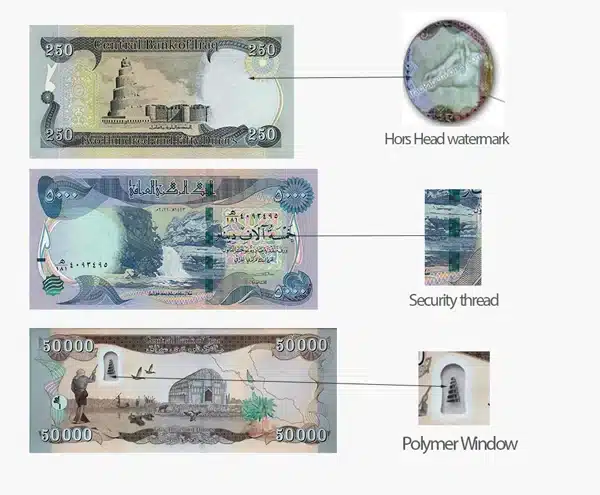
01 / LIGHT The watermark
Hold the note up to a soft light source. Examine the unprinted watermark area and compare the motif, position and tonal detail with the same issue. The upper example in the plate identifies a horse-head watermark on the illustrated 250-dinar note; do not extend that motif to every Iraqi banknote.
Ask for: a clear transmitted-light photograph of the watermark area, alongside a normal photograph of both sides. A pale printed shape in an ordinary listing photograph is not enough to verify a watermark.
02 / THROUGH & TILT The security thread
Locate the thread independently of the watermark and window. Compare its position, width, any visible lettering and its appearance in transmitted light. Where the documented issue uses a windowed or optically variable thread, also compare the exposed segments and their response as you tilt the note.
Look closely: the middle image highlights the thread area on a 5,000-dinar example. A flat photograph can locate that area, but it cannot demonstrate the complete light-dependent effect. Request a short unfiltered tilt video when buying remotely.
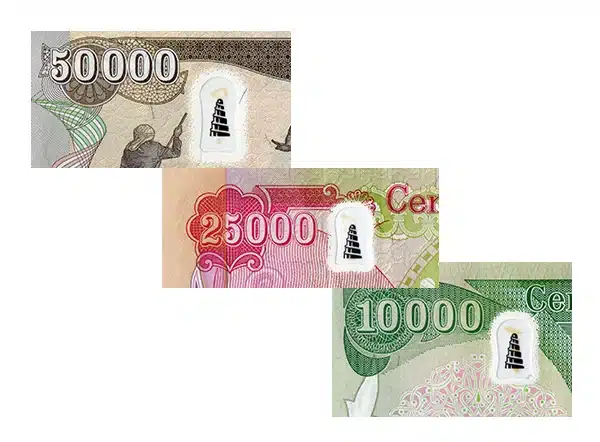
03 / CHANGE THE LIGHT The secure window
A secure window is distinct from a watermark and from the narrow security thread. Examine it from both sides, in transmitted and oblique light, and against light and dark backgrounds. Compare the motif and its changes with the documented issue rather than judging transparency alone.
One documented example is the 50,000-dinar note dated 2015: Regula’s examination describes a varifeye window formed with transparent film in a paper banknote. Its spiral-minaret motif is visible in transmitted light and changes appearance in oblique light and on a dark background. View the examination and close-ups ↗
04 / MAGNIFY & COMPARE Print, fine detail and UV
Complete the examination with the issue’s documented raised printing, fine lines, small lettering and front-to-back registration. Use magnification without scraping or marking the surface. If UV features are documented, compare their location and response with the same issue under suitable equipment; paper wear, contamination and lighting can affect what you see.
Build a useful record: full front and reverse photographs, a backlit watermark and thread view, window close-ups and a tilt video. These complement each other; one attractive security image does not authenticate the entire note.
03 / The collection, in focus
Six notes. Six closer looks.
These original photographs from Collectible Money show the fronts of six Iraqi banknotes. Use them to compare design and denomination; they are not backlit or UV examination images. Open a photograph for a larger view.
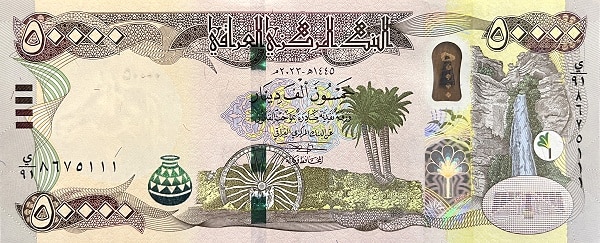
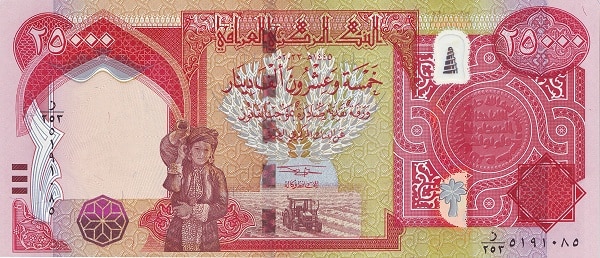
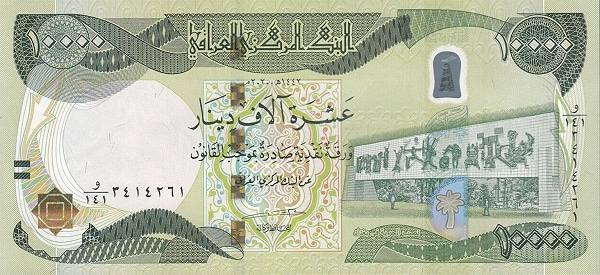
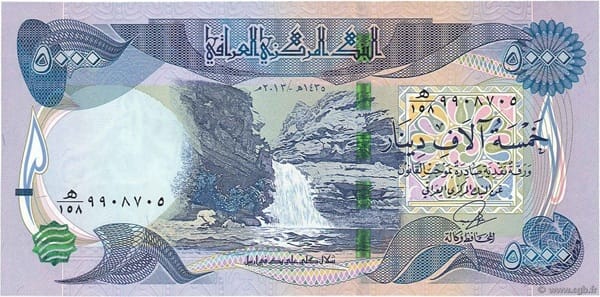
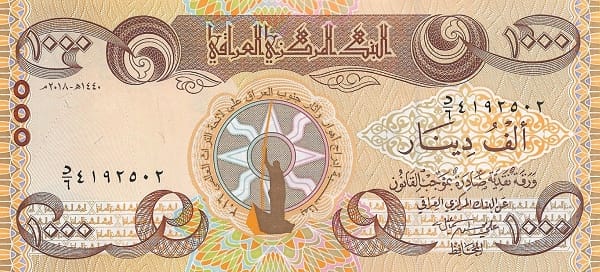
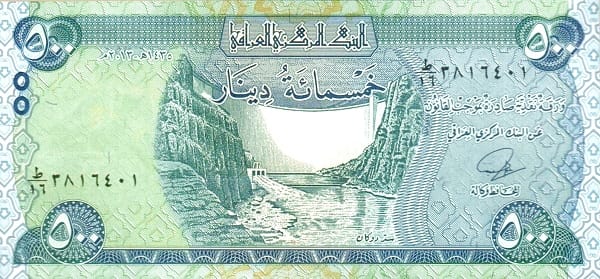
The photographs illustrate the banknotes available in our image collection. Do not infer matching years, serials, dimensions or security specifications across this selection. For both sides and exact listing details, explore our Iraqi dinar collection.
04 / Two different questions
Genuine and uncirculated are not synonyms.
Authenticity
Does the note’s issue, material, printing and security behavior agree with the genuine reference? An appealing condition label cannot answer that question.
Condition
How much handling, folding, staining, damage or repair is present? A genuine note can be circulated; a suspicious note can look crisp and clean.
Assess the two questions separately. Inspect both sides and the edges, and ask whether there are repairs, pressing, writing, stains or other changes. For terminology and handling checks, continue with our banknote grading guide: UNC, XF and VF.
The collector’s perspective
Read the whole note.
Design, denomination, issue and condition belong in the same record. Keep clear photographs of both sides with your collection notes.

05 / Before committing
A better buying checklist.
A useful listing makes identification easier. Ask specific questions, request the photographs you need and keep the seller’s description with your purchase record.
- Confirm what is pictured. Are the photographs of the actual note, a representative example or a lot? Request the exact serial if that matters to your collection.
- Ask for both sides. Request a full, sharp front and reverse view, followed by close-ups of the areas needing verification.
- Check the exact issue. Compare the printed date and design with the issuing bank’s reference. Do not rely on a broad “post-2003” label alone.
- Separate wear from uncertainty. A fold or faded color can be a condition issue. A feature mismatch needs its own assessment.
- Read the terms. Understand the stated grade, return conditions and what the seller means by an authenticity guarantee before purchasing.
The CBI’s banknote-handling instructions distinguish issues of fitness and damage from counterfeit notes. That distinction reinforces an essential collector habit: do not use physical wear alone as an authentication decision. CBI handling and sorting reference ↗
When a photograph is not enough.
If the watermark, thread, paper or optical behavior cannot be assessed from the supplied images, ask for better evidence or an in-hand examination. A purchase can wait; an unsupported conclusion should not take its place.
06 / Collector questions
Before you put the note away.
Can I authenticate Iraqi dinar from a photograph?
A photograph can help identify a design and reveal visible inconsistencies. It cannot fully test paper, raised print, transmitted-light features or angle-dependent effects. Use it to decide which further checks are needed.
Does every Iraqi banknote have the same features?
No universal checklist should be applied without identifying the issue. Compare the same denomination and design with the CBI reference, and account for documented issue changes.
Is a very crisp note automatically genuine?
No. Crispness relates to appearance and condition. Authenticity requires a consistent match across the correct issue, paper, printing and expected security behavior.
What should I do when details do not match?
Stop and establish whether you are comparing the correct issue. If the discrepancy remains, ask an experienced banknote specialist to inspect the note before you buy or make a firm claim about authenticity.
Sources worth keeping close.
Use the issuing bank’s material for issue identification and detailed specifications. The photographs on this page are original site media, not official security diagrams.
- Central Bank of Iraq — circulating banknotes and issue designs
- Central Bank of Iraq — Iraqi banknote guide
- Central Bank of Iraq — 7 October 2018 issue announcement
- Central Bank of Iraq — banknote handling, sorting and replacement guidance
- Regula — secure-window examination, including Iraq 50,000 dinars (2015)
- Louisenthal — varifeye secure-window technology
Prepared by Collectible Money · Editorial review: 21 October 2026.