
A collector’s exhibition · Three chapters
Old Turkish lira.Three eras, side by side.
From millions to Yeni, then lira. Read the wording, compare the designs and build a collection with a clear story.
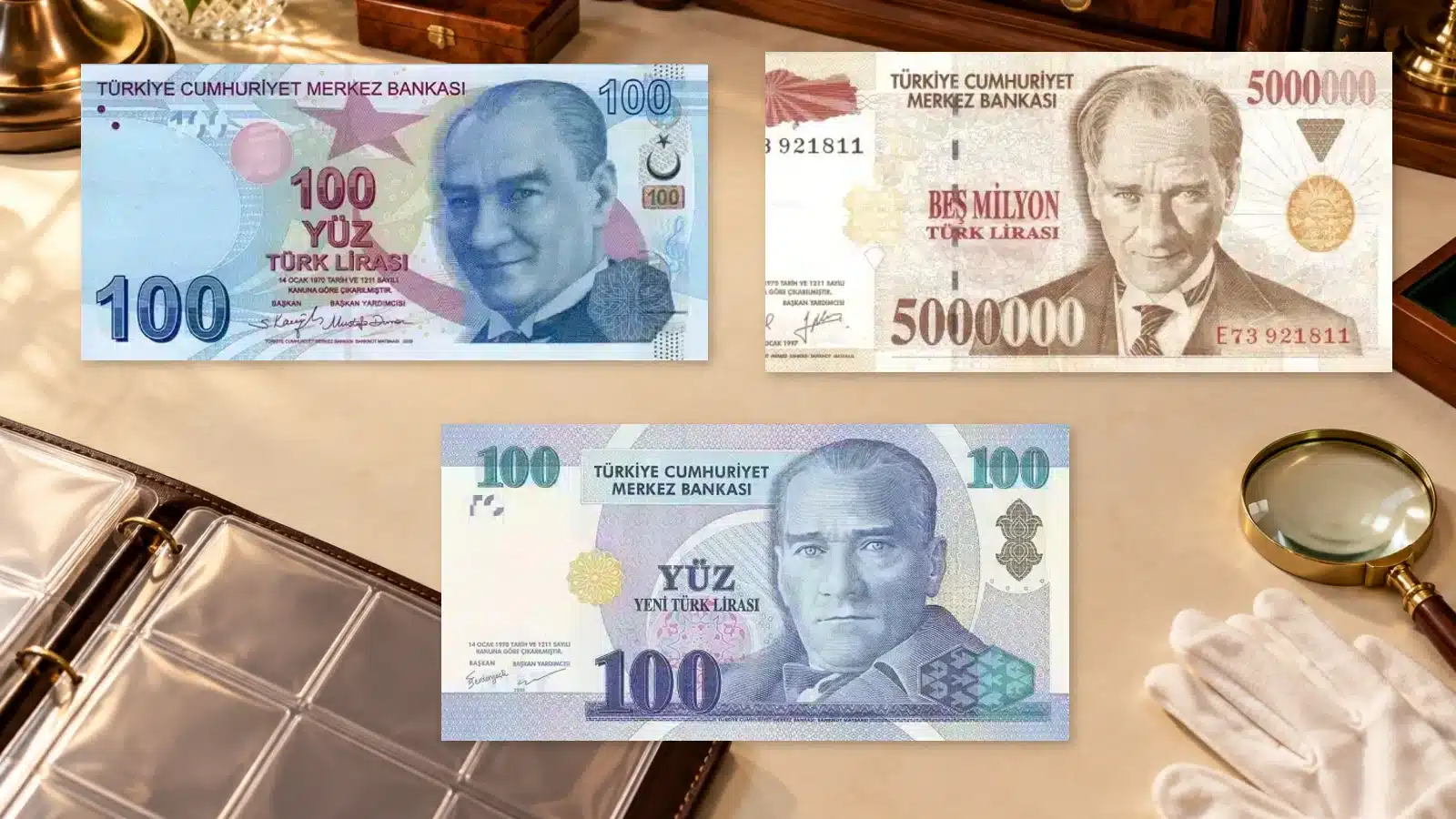
A million-lira note and a hundred-lira note can belong to very different chapters of the same currency.
01 / A short visual timeline
From millions to Yeni, then lira.
Old Turkish lira banknotes offer an accessible way to study changing denominations and design. The most useful first distinction is between notes issued before the 2005 reform, the transitional Yeni Türk Lirası issue, and the later Türk Lirası series. Similar portraits do not make them interchangeable.
The Central Bank of the Republic of Türkiye records two stages of reform: six zeros were removed and Series 8 New Turkish lira notes entered circulation on 1 January 2005. On 1 January 2009, the temporary “New” prefix was removed and Series 9 Turkish lira notes entered circulation.
| Era | Identification cue |
|---|---|
| Before 2005 | Older designs, including high denominations expressed in thousands or millions. |
| 2005 YTL / E8 | The currency wording includes “YENİ TÜRK LİRASI”. |
| 2009 onward / E9 | The later series uses “TÜRK LİRASI” without “YENİ”. |
This is a series framework. It does not tell you the exact printing, signature combination or catalog variety of a particular example.

02 / Look beyond the portrait
One word changes the identification.
Atatürk appears on the fronts of the three examples in this guide, so the portrait alone cannot separate the eras. Read the currency wording beside the denomination. On the illustrated YTL note, “YENİ” is the key difference; on the later 100-lira note, that word is absent and the layout has changed.


The arithmetic of removing six zeros is straightforward: one million old lira corresponded to one new lira at the reform. However, that historical conversion is not a present-day collector price. Collectible examples are described and sold by their issue, condition and other individual characteristics.
03 / The date trap
What does “14 Ocak 1970” mean?
A date printed in a legal statement should not be copied automatically into the “year of issue” field of your album. The illustrated notes include wording referring to a law dated 14 January 1970. The CBRT identifies that date with its Law No. 1211; it is a legal reference, not proof that every note bearing it was printed in 1970.
Read the whole inscription.
Separate the date of the law from the series, release date, printing or signature variety. Compare both faces and an authoritative catalog entry before assigning a year. Moreover, image filenames and broad dealer labels can preserve older naming conventions.
For a useful record, write the denomination, currency wording, emission group, identified variety, signatures, serial and condition in separate fields. If you have only established the series, record that first and leave the more precise attribution open until checked.
04 / Build with a purpose
Three collection routes worth considering.
A reform comparison
Choose one old-lira note, one YTL note and one later-lira example. Compare wording and layout, and explain the two reform dates on your album page.
A denomination set
Choose one series and collect its specified denominations. Check exactly what “complete” means in the listing before assuming every printing or variety is included.
A third route is a focused design study: collect fronts and reverses that interest you and research the people, buildings or landscapes after confirming each note’s identification. You can develop that project gradually without buying every available denomination.
For the transitional era, compare the 2005 YTL set. Alternatively, examine the six-note Turkish lira set. To explore high old-lira values, review the one-to-twenty-million-lira set listing and check its stated contents. Do not assume a mixed selection includes every variety in an emission group.
05 / Choose the right listing
Compare contents, condition and attribution.
Read denomination and quantity separately. A set of six notes may give six different face values; a lot of six may repeat one value. Also, ask whether the photographs show the actual examples or representative stock and whether signatures, dates or serials may vary.
- Choose the era first: old lira, YTL or the later lira series.
- Confirm the contents: list every included denomination and check whether you already own it.
- Check the grade: examine both sides, corners and edges; use the grading guide for condition terminology.
- Verify a specific requirement: if you need one signature or catalog variety, ask before ordering a general stock listing.
- Keep a record: retain the description, invoice and photographs with your attribution.
Use the Turkish banknote collection to compare the available eras. Begin with the scope that interests you; a coherent three-note comparison can be a better first project than a large unplanned assortment.
06 / Questions & sources
Understand what the label promises.
Are old Turkish lira and YTL the same issue?
No. YTL refers to the New Turkish lira introduced in the 2005 reform. Identify the actual note from its wording and design.
Does a million-lira face value make a note rare?
No. However, the size of the printed denomination does not establish rarity. Research the exact issue, condition and availability separately.
Does “complete set” include every signature variety?
Only if the listing explicitly says so. Many denomination sets contain one example of each stated value, rather than every printing or signature combination.
Why should I photograph the reverse?
In addition, the reverse adds design and denomination evidence and helps document condition. A front-only collection record omits useful identification details.
Sources & image notes
CBRT Virtual Museum: history of banknote printing and the 2005/2009 reform · CBRT: banknote printing authority and Law No. 1211.
Original full-face photographs from Collectible Money; no generated or redrawn notes. Editorial review: 22 October 2026.