

“`html
Why collectors choose this banknote
- 2009–2021 issue range
- UNC condition
- Authentic collector banknote
- Worldwide protected shipping
- Easy addition to an existing collection
The Syria 100 Pounds banknote combines archaeological, architectural, and numismatic subjects within one distinctive modern Syrian design. Available in 2009 and later 2021 varieties, this denomination is an excellent entry point for collectors building an organized Syrian paper money collection.
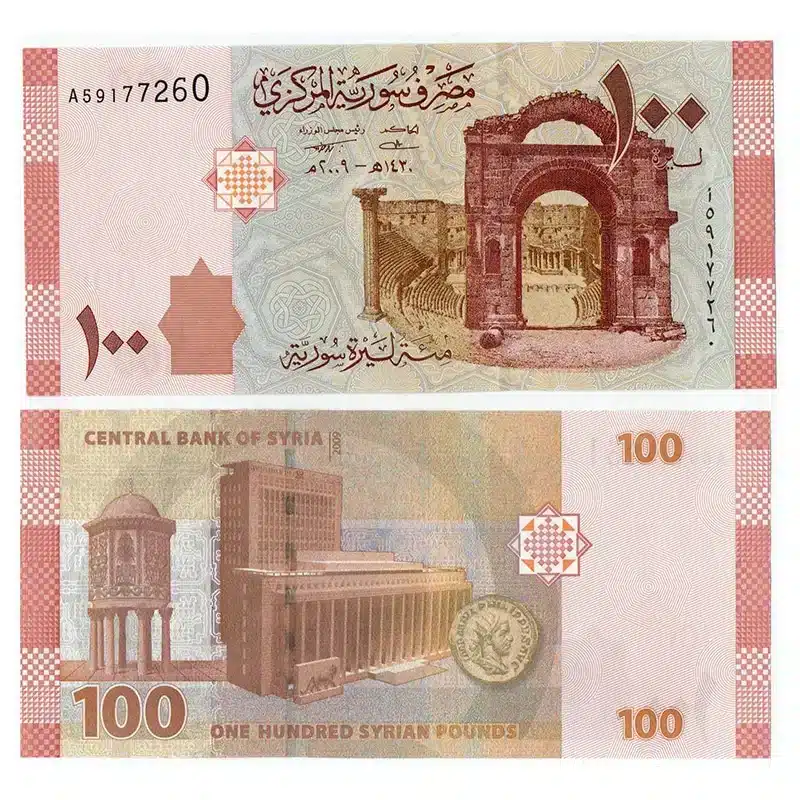
The earlier 2009 issue is catalogued as Pick P#113, while the 2021 fractional-serial variety is identified as P#113c. Although both versions share the same principal artwork, collectors can distinguish them through their dates, serial-number formats, printing details, and selected security features. Each banknote offered here is supplied in crisp UNC (Uncirculated) condition.
Collector’s Snapshot
Banknote Specifications
The original 2009 issue was introduced into circulation on 27 July 2010. Later versions retained the principal design while introducing changes to serial numbering and selected production details. Therefore, the exact date, serial number, and prefix supplied may vary according to available stock.
Browse additional issues in our Middle East banknotes collection.
Front Design | Bab el-Hawa & Bosra Amphitheatre
Ancient Architecture of Bosra
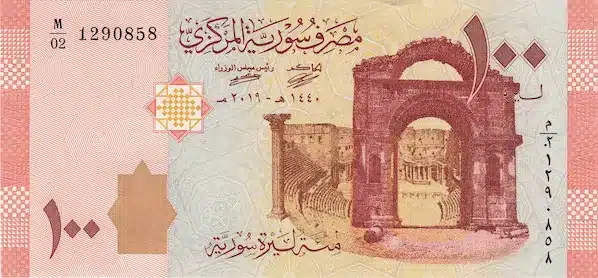
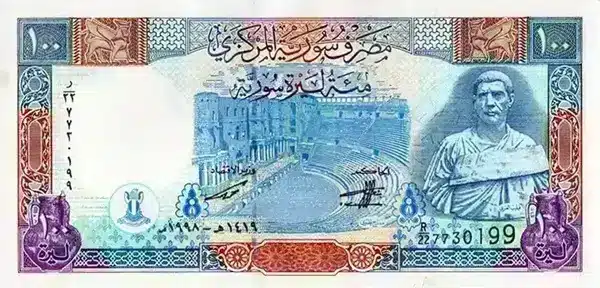
The front of the Syria 100 Pounds banknote focuses on the ancient city of Bosra. One of its principal subjects is Bab el-Hawa, or Gate of the Wind, the western gate positioned at the end of the city’s historic Decumanus Maximus.
Built from dark basalt stone, the gate connects the banknote directly with Bosra’s surviving Roman-era urban architecture.
Alongside it appears the celebrated Bosra Amphitheatre. This monumental structure provides another recognizable archaeological element and strengthens the note’s connection with Syria’s ancient architectural heritage.
Arabic inscriptions identify the issuing institution and the 100 Pounds denomination. Consequently, the front works particularly well for collectors interested in archaeology, Roman architecture, and Syrian heritage sites.
Reverse Design | Damascus & Philip the Arab
Architecture and Ancient Numismatics
The reverse brings together several different historical subjects rather than relying on a single monument.
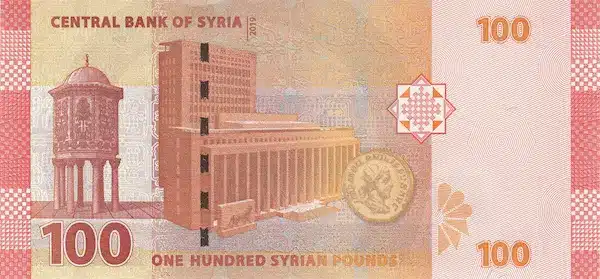
One prominent element is the Dome of the Treasury at the Umayyad Mosque in Damascus. This historic structure adds an important Islamic architectural theme to the denomination.
Also represented is the Central Bank of Syria building at Sabaa Bahrat Square, or Square of the Seven Fountains, in Damascus. Therefore, the reverse creates an interesting visual connection between historic and modern Syrian institutions.
A particularly relevant detail for numismatists is the depiction of an ancient Roman silver Antoninianus coin of Emperor Philip the Arab. Philip I, commonly known as Philip the Arab, ruled the Roman Empire from AD 244 to 249.
As a result, this banknote has an unusual collecting connection: it is modern paper money that incorporates an ancient coin directly into its artwork.
2009 P#113 vs 2021 P#113c
Collectors can distinguish the earlier and later varieties through several production details.
- 2009 P#113: Uses the earlier ascending-size serial-number format.
- 2021 P#113c: Uses a fractional serial number with characters of consistent size.
- Reverse Ornament: The later variety adds a chevron ornament at the lower-right area of the reverse.
- Fluorescent Detail: The earlier version includes a fluorescent stripe that is absent from the later variety.
Therefore, collectors building a date or variety collection may choose to keep both versions even though their principal artwork remains closely related.
Printing & Security Features
- Watermark: Arabian horse head with electrotype 100.
- Security Thread: Embedded security strip visible when examined against transmitted light.
- UV Activity: Selected printed elements respond under ultraviolet illumination.
- Serial Variation: Serial-number format helps distinguish the earlier and later varieties.
- Paper: Printed on cotton-based banknote paper.
- Dimensions: Approximately 140 × 65 mm.
The 2009 P#113 was produced by Oesterreichische Banknoten- und Sicherheitsdruck GmbH in Vienna, Austria. By comparison, the later fractional-serial variety is associated with Goznak in the Russian Federation.
Collector Intelligence
Why This 100 Pounds Note Stands Out
Many modern banknotes focus on a single landmark or portrait. In contrast, this Syrian denomination brings together Roman archaeology, Islamic architecture, a modern central-bank building, and even an ancient coin.
Moreover, its Bosra imagery complements the larger 1000 Pounds P#116 without simply duplicating the same collecting role. For collectors building a broader Syrian series, the 100 Pounds denomination therefore adds both visual diversity and historical depth.
A Banknote with a Numismatic Detail
The depiction of Philip the Arab’s Roman coin is especially interesting for collectors. Instead of separating coin collecting from paper-money collecting completely, this design places an ancient numismatic object directly on a modern banknote.
Consequently, P#113 can also appeal to collectors interested in banknotes depicting coins, Roman history, or historically themed currency designs.
Collection Position
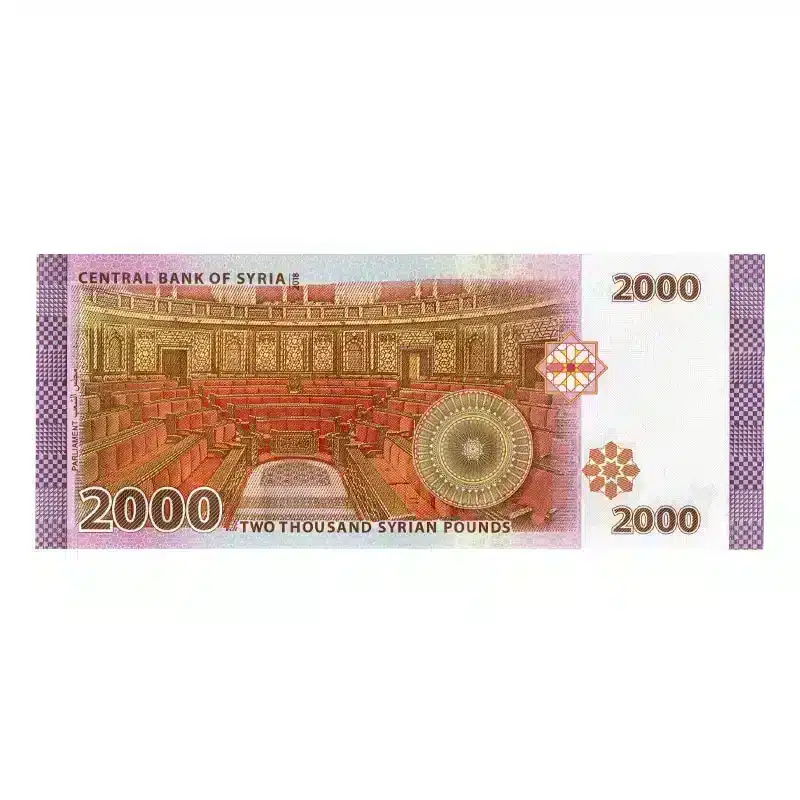
For denomination-based collectors, the 100 Pounds issue provides a natural starting point before moving upward to the 200 Pounds, 500 Pounds P#115, 1000 Pounds P#116, 2000 Pounds P#117, and later 5000 Pounds denomination.
Alternatively, a thematic collection can position this note alongside banknotes depicting Bosra, Damascus, Roman monuments, ancient coins, or major Middle Eastern archaeological sites.
Collector Checklist
- Two collectible varieties: 2009 P#113 and later 2021 P#113c.
- Bosra imagery: Bab el-Hawa and Bosra Amphitheatre appear on the front.
- Damascus heritage: The reverse incorporates the Dome of the Treasury and Central Bank building.
- Numismatic connection: An ancient coin of Philip the Arab appears in the reverse design.
- Security interest: Arabian horse watermark, electrotype 100, security strip, and UV elements.
- UNC condition: Suitable for clean album presentation and organized collector storage.
Archival Storage
- Use archival protection: Place the banknote inside an acid-free, PVC-free currency sleeve.
- Protect the surface: Handle the note carefully by its edges with clean, dry hands.
- Control the environment: Store away from direct sunlight, excessive humidity, and heat.
- Preserve UNC quality: Finally, avoid folding, laminating, taping, or attaching labels directly to the banknote.
Secure Payment & Worldwide Shipping
- Preparation: Orders are normally prepared within 1–3 business days.
- Protection: The banknote is carefully protected before shipment.
- Variety Notice: Date, serial number, and prefix may differ from the photographed example.
- Combined Shipping: In addition, combined shipping is available when ordering multiple Syrian or world banknotes.
Continue Your Syrian Collection
Browse the Middle East banknotes collection for additional Syrian and regional paper money.
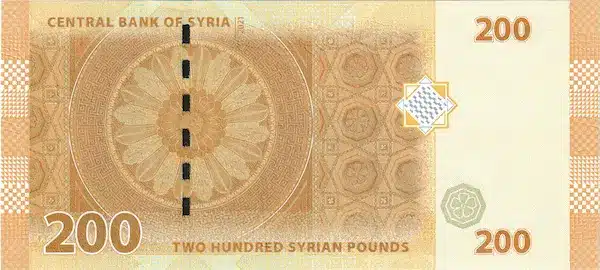
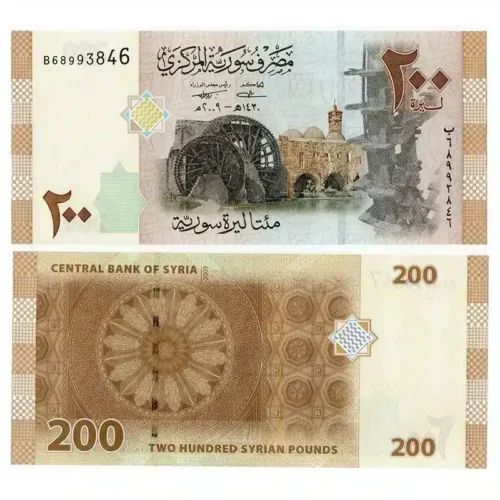
Collectors building an ascending Syrian denomination sequence can continue with the Syria 200 Pounds banknote, followed by the Syria 500 Pounds P#115 and higher denominations.
Add this Syria 100 Pounds UNC banknote to your collection as a modern Syrian issue connecting Bosra’s Roman heritage, historic Damascus, and ancient numismatics.
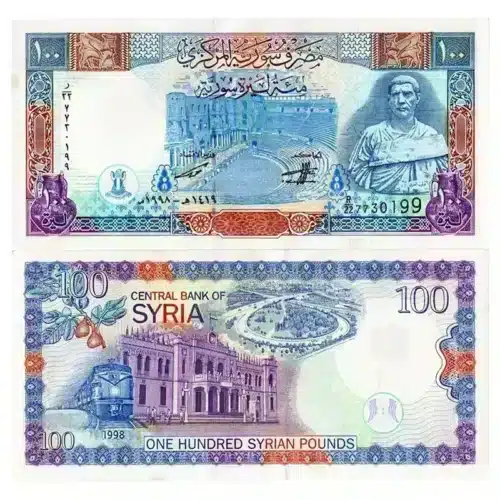
Compare this issue, another edition, or a complete set
Review the closest catalogue variants, collection sets, and denomination options without starting a new search.
Use these options to fill a missing issue or complete more of the series in fewer purchases.
“`
Reviews
There are no reviews yet