

Why collectors choose this banknote
- 2013 issue
- UNC condition
- Authentic collector banknote
- Worldwide protected shipping
- Easy addition to an existing collection
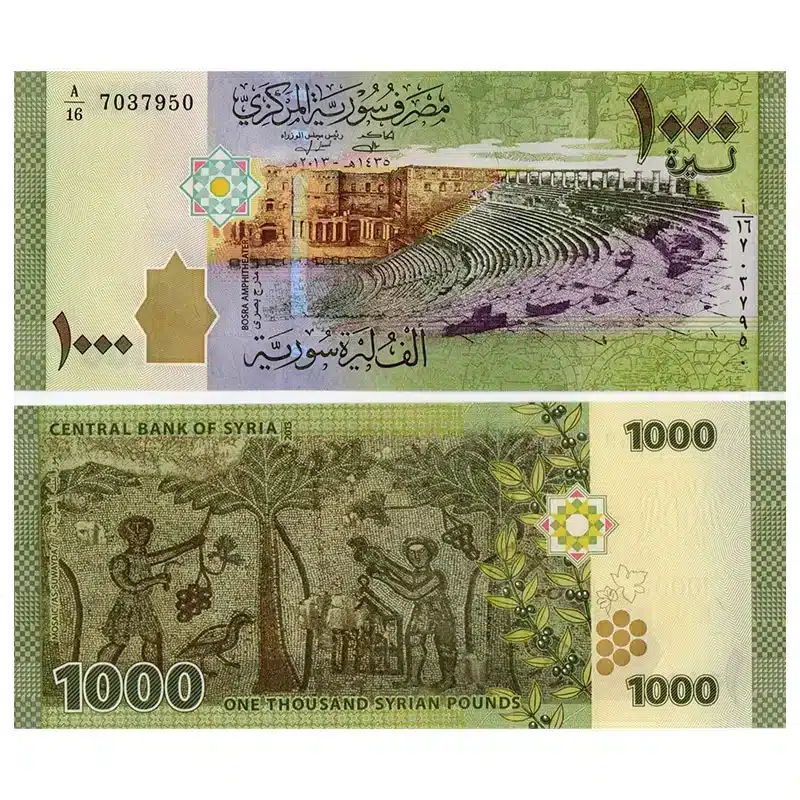
The Syria 1000 Pounds 2013 banknote combines archaeology, Roman-era art, and Syrian cultural heritage within a distinctive modern currency design. Issued by the Central Bank of Syria and catalogued as Pick P#116, this example is supplied in crisp UNC condition for collectors of Syrian and Middle Eastern paper money.
Unlike portrait-centered banknotes, this issue focuses on two archaeological subjects. The front presents the ancient Roman amphitheater at Bosra, while the reverse features a Roman grape-harvest mosaic associated with As-Suwayda. Therefore, the note offers collectors two very different views of Syria’s ancient heritage within a single design.
Collector’s Snapshot
Banknote Specifications
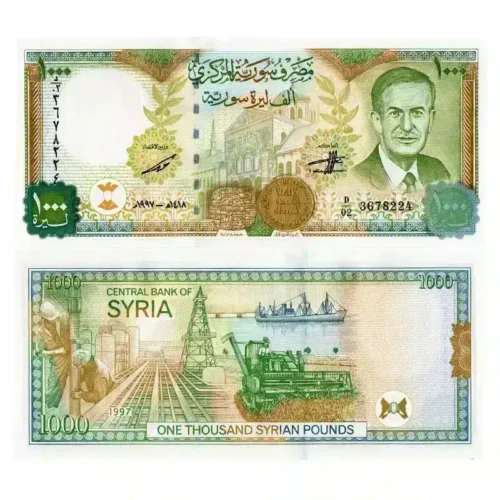
Although the banknote carries the date 2013, the issue entered circulation in July 2015. Serial numbers and prefixes may vary from the illustrated example; however, the supplied banknote follows the same P#116 type and UNC collector condition.
You can also browse our Middle East banknotes collection for additional regional issues.
Front Design | Bosra Roman Amphitheater
Ancient Architecture from Southern Syria
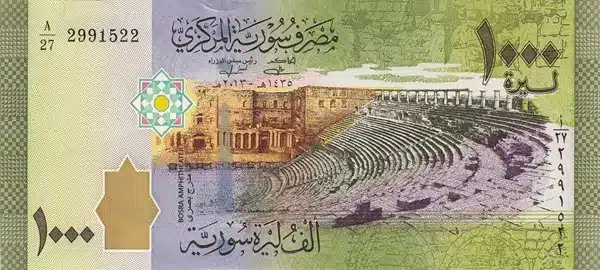
The obverse is dominated by the ancient Roman amphitheater at Bosra. Constructed from the dark basalt associated with the region, the monument creates a strong architectural subject for the front of the banknote.
Arabic inscriptions identify the issuing authority and denomination. In addition, the date appears in both Hijri and Gregorian forms, while the value is presented as one thousand Syrian pounds.
Rather than using a political portrait as its principal subject, P#116 places Syrian archaeological heritage at the center of the composition. As a result, the front is particularly interesting for collectors who organize banknotes by architecture, archaeology, or Roman-period themes.
Reverse Design | Roman Grape-Harvest Mosaic
Ancient Mosaic from As-Suwayda
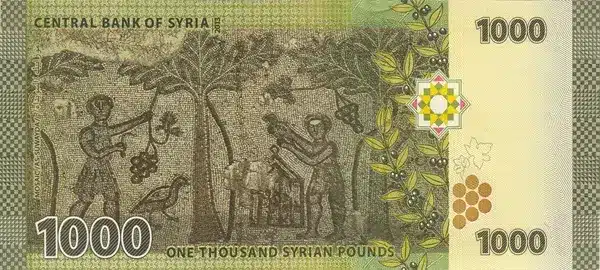
The reverse changes from monumental architecture to ancient decorative art. Its principal subject is a Roman-era mosaic depicting a grape-harvest scene from the As-Suwayda region.
The agricultural scene adds a human and cultural dimension to the note. Moreover, olive branches complement the mosaic imagery and reinforce the agricultural theme.
English inscriptions identify the Central Bank of Syria, the 2013 date, and the denomination as ONE THOUSAND SYRIAN POUNDS. Consequently, the reverse provides a strong visual contrast with the architectural character of the front.
Together, the Bosra amphitheater and As-Suwayda mosaic make this issue particularly suitable for a collection centered on Syrian archaeology and cultural heritage.
Printing & Security Features
The P#116 issue combines its archaeological artwork with several security elements. Most notably, collectors can examine:
- Watermark: Syrian coat of arms together with an electrotype 1000.
- Security Thread: A vertical windowed holographic security thread incorporated into the note.
- Microperforation: Denomination-related perforation forms part of the security design.
- UV Elements: Selected fibers, denomination elements, and design areas react under ultraviolet light.
- Raised Printing: Intaglio elements provide tactile detail in selected areas.
- Registration Element: A mosaic-inspired registration device complements the overall design.
Therefore, P#116 is useful not only as a Syrian type note but also for collectors interested in comparing modern banknote security techniques.
Collector Intelligence
Why P#116 Stands Out
Many modern banknotes use portraits or state symbols as their dominant imagery. By comparison, this Syrian issue places archaeology and ancient art at the center of both sides.
The Bosra amphitheater creates an architectural theme on the front. Meanwhile, the grape-harvest mosaic provides a completely different archaeological subject on the reverse. Consequently, the note works particularly well within collections organized around monuments, ancient civilizations, or cultural heritage.
Understanding the 2013 Date
Collectors may notice an apparent difference between the date printed on the banknote and its actual introduction. The note is dated 2013; however, it was introduced into circulation on 30 July 2015.
For catalogue organization, therefore, it is useful to retain 2013 as the banknote’s stated year while recognizing 2015 as its circulation introduction date.
Collection Position
This Syrian 1000 Pounds P#116 banknote fits naturally into a modern Syrian denomination collection. Additionally, it can complement broader Middle Eastern paper-money collections or specialized groups focused on archaeological sites depicted on world banknotes.
Because this listing is for a single UNC example, it is particularly suitable for collectors who need one clean representative of P#116 rather than a multiple-note lot.
Collector Checklist
- Correct type: Syrian 1000 Pounds catalogued as P#116.
- UNC condition: Supplied as an uncirculated collector example.
- Distinct front: Bosra Roman amphitheater.
- Distinct reverse: Roman grape-harvest mosaic from the As-Suwayda region with olive branches.
- Security interest: Watermark, security thread, microperforation, and additional printed security elements.
- Collector context: Suitable for Syrian, Middle Eastern, archaeological, and architectural banknote collections.
Collector FAQ
What appears on the front of the Syria 1000 Pounds P#116?
The front features the ancient Roman amphitheater at Bosra. Therefore, the note has a strong archaeological and architectural identity rather than relying on a portrait as its main subject.
What appears on the back?
The reverse depicts a Roman-era grape-harvest mosaic associated with As-Suwayda. In addition, olive branches appear within the reverse composition.
Why does the banknote say 2013 if it was issued later?
The banknote itself is dated 2013. However, this P#116 type was introduced into circulation on 30 July 2015. Therefore, 2013 remains the appropriate date when identifying the printed issue.
Will the serial number match the product photograph?
Not necessarily. Serial numbers and prefixes may vary from the illustrated example. Nevertheless, the supplied banknote will correspond to the same denomination and P#116 type described in this listing.
Preservation Tips
- Use archival storage: Keep the banknote inside an acid-free currency sleeve.
- Protect the surface: Handle the note by its edges with clean, dry hands.
- Control the environment: Store it away from direct sunlight, excessive humidity, and heat.
- Preserve UNC quality: Avoid folding, laminating, taping, or attaching the banknote to album pages with adhesives.
Collector Takeaway
The Syria 1000 Pounds P#116 combines the Roman amphitheater of Bosra with an ancient grape-harvest mosaic from As-Suwayda, giving collectors two distinctive archaeological subjects in one UNC Syrian banknote.
Secure Payment & Worldwide Shipping
Your banknote is carefully protected for collector-safe shipment. In addition, combined shipping is available when purchasing multiple Syrian or world banknotes.
Continue Your Collection
Browse our Middle East banknotes collection to discover additional Syrian and regional paper money.
Add this Syria 1000 Pounds 2013 P#116 UNC banknote to your collection as a distinctive Syrian issue combining Roman architecture and ancient mosaic art.
Compare this issue, another edition, or a complete set
Review the closest catalogue variants, collection sets, and denomination options without starting a new search.
Use these options to fill a missing issue or complete more of the series in fewer purchases.
Reviews
There are no reviews yet