
Why collectors choose this banknote
- 1997 issue
- UNC condition
- Authentic collector banknote
- Worldwide protected shipping
- Easy addition to an existing collection
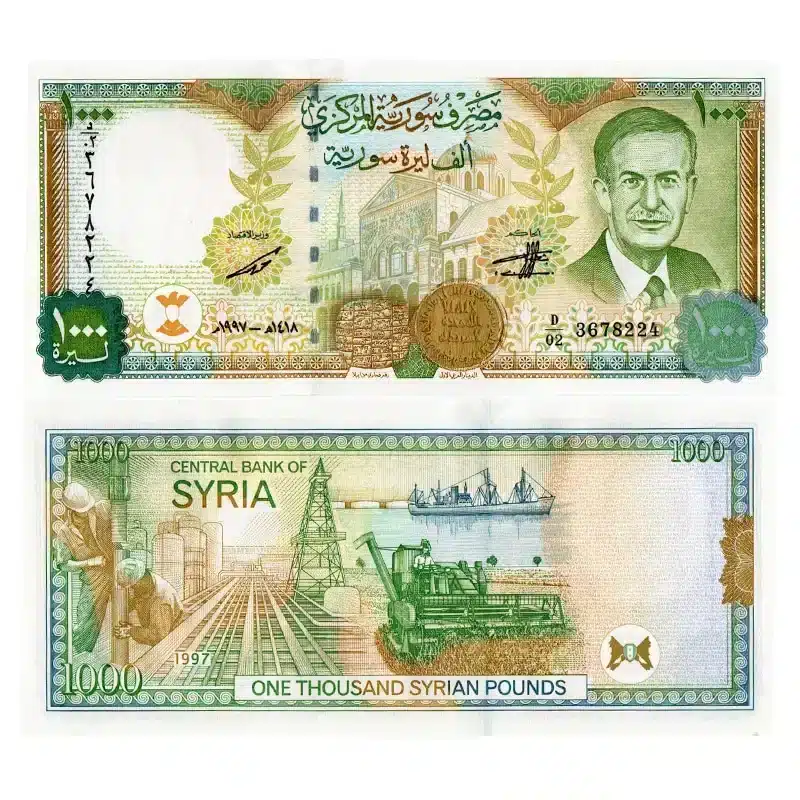
The Syria 1000 Pounds 1997 banknote completes the P#107–P#111 sequence as both its highest denomination and final catalogue position. Issued by the Central Bank of Syria and catalogued as Pick P#111, this UNC banknote combines political and architectural imagery on the front with petroleum, agriculture, and maritime commerce on the reverse.
Unlike the preceding denominations, P#111 places a portrait of President Hafez al-Assad alongside the Umayyad Mosque in Damascus. Meanwhile, the reverse shifts toward productive sectors of the Syrian economy through petroleum infrastructure, a combine harvester, and a cargo ship. Consequently, this 1,000 Pounds note provides a distinctive conclusion to the complete five-note P#107–P#111 group.
Collector’s Snapshot
Banknote Specifications
Explore additional regional issues in our Middle East banknotes collection.
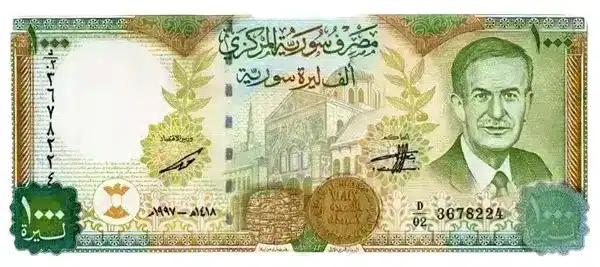
Front Design | Hafez al-Assad & Umayyad Mosque
Portrait of President Hafez al-Assad
The front prominently features President Hafez al-Assad, whose portrait forms one of the principal visual elements of the denomination. As a result, P#111 is immediately distinguishable from several of the lower values in the P#107–P#111 sequence.
For collectors arranging the complete series, this portrait also gives the final denomination a clearly different visual identity. Furthermore, it provides a recognizable reference point for collectors studying Syrian banknotes from the late twentieth century.
Umayyad Mosque in Damascus
Alongside the portrait appears the Umayyad Mosque in Damascus, one of the major architectural subjects associated with the Syrian capital.
The mosque introduces an architectural and cultural dimension to the front design. Therefore, the composition combines a contemporary presidential portrait with one of Damascus’s best-known historic monuments rather than relying on a single visual theme.
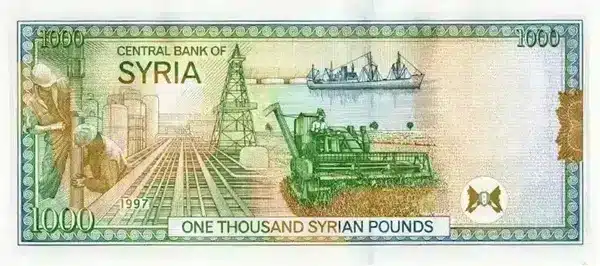
Reverse Design | Petroleum, Agriculture & Maritime Trade
Petroleum Industry
The reverse introduces an economic theme through imagery associated with the petroleum industry. This industrial subject separates P#111 from the archaeological and historical imagery found on several earlier denominations in the sequence.
Moreover, petroleum provides one component of a broader design devoted to productive economic activity.
Combine Harvester & Agriculture
Agricultural production is represented by a combine harvester. Consequently, the design moves beyond industrial energy and also recognizes mechanized farming.
For thematic collectors, this element gives the banknote an additional connection with agriculture, machinery, and economic-development subjects.
Cargo Ship & Commerce
A cargo ship adds another dimension to the reverse. Whereas petroleum represents energy and the harvester represents agriculture, the ship introduces transport and commercial activity.
Together, these three subjects create a broad economic composition. Therefore, the reverse can be read as a combination of energy, agriculture, and trade rather than as one isolated industrial scene.
Design Identity of Syria P#111
P#111 has one of the broadest thematic combinations within this five-note series. On one side, Hafez al-Assad and the Umayyad Mosque establish a political and architectural identity. On the other, petroleum, mechanized agriculture, and maritime transport present three different areas of economic activity.
Consequently, the note creates a strong visual conclusion to the sequence. It also gives thematic collectors several ways to position the banknote within collections devoted to Syria, Middle Eastern paper money, architecture, political portraits, agriculture, industry, or transportation.
Collector Intelligence
Why P#111 Completes the Series
The importance of P#111 within this particular collection is straightforward: it represents the final catalogue position and highest denomination in the five-note P#107–P#111 group.
A collector progressing through the sequence reaches this note after 500 Pounds P#110. Therefore, adding P#111 completes the denomination progression from 50 Pounds through 1,000 Pounds.
A Different Theme from P#110
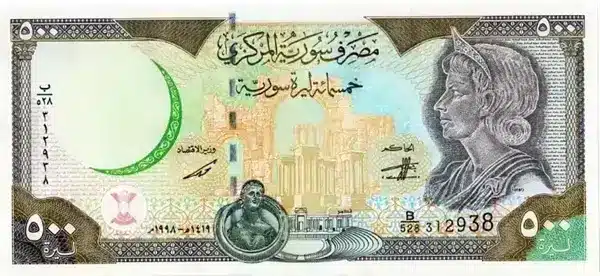
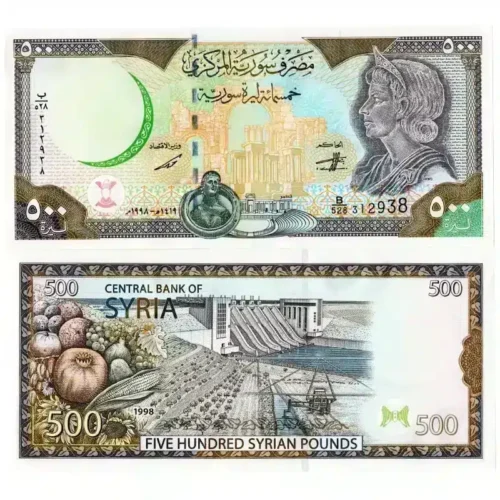
The transition from P#110 to P#111 is particularly interesting. P#110 focuses on Queen Zenobia, Palmyra, the Euphrates Dam, and agriculture. By comparison, P#111 introduces Hafez al-Assad and the Umayyad Mosque before expanding the reverse into petroleum, mechanized farming, and maritime commerce.
As a result, the two highest denominations remain visually and thematically distinct even when displayed beside each other in the same album.
Collection Position | Final Note in P#107–P#111
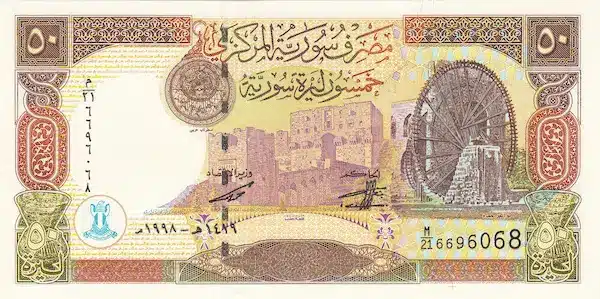
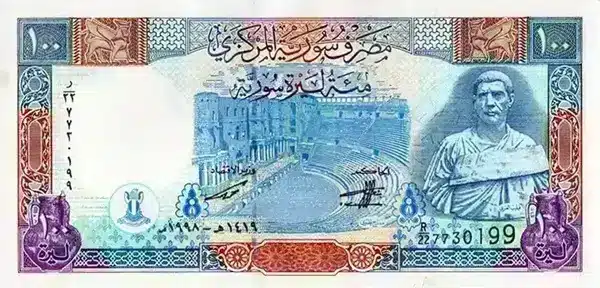
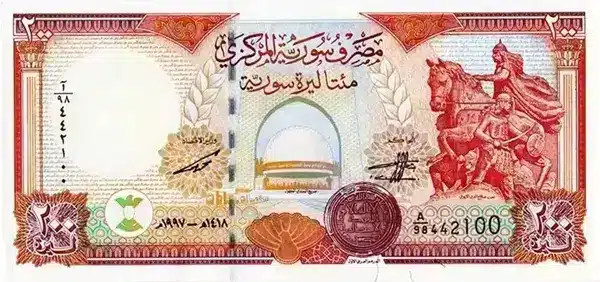
The complete five-note catalogue progression is:
P#107 → P#108 → P#109 → P#110 → P#111
Its denomination sequence is equally clear:
50 → 100 → 200 → 500 → 1,000 Syrian Pounds
Accordingly, P#111 closes both progressions at once. It is the highest face value in the group and the final Pick number needed to complete the sequence.
This makes the 1,000 Pounds note especially relevant for collectors who already own P#107 through P#110 and want to finish the complete five-denomination group.
Collector Checklist
- Pick P#111: Final catalogue position in the five-note sequence.
- 1,000 Pounds: Highest denomination represented in the group.
- Hafez al-Assad: Prominent presidential portrait on the front.
- Damascus architecture: Umayyad Mosque accompanies the portrait.
- Economic reverse: Petroleum, agriculture, and cargo transport create a multi-sector theme.
- UNC condition: Suitable for clean album presentation and protected collector storage.
Collector Decision | Why Add the 1,000 Pounds P#111?
For a collector building the P#107–P#111 sequence, this denomination has an obvious purpose: it completes the set. Without P#111, the denomination progression stops at 500 Pounds and the catalogue sequence remains unfinished.
However, the banknote also works independently. Collectors interested in Syrian political portraiture may focus on Hafez al-Assad, while architecture collectors can appreciate the Umayyad Mosque.
Meanwhile, the reverse provides three additional collecting themes through petroleum production, agricultural machinery, and maritime transport. Thus, P#111 can occupy several thematic positions beyond its role as the final note of the series.
Archival Storage Recommendations
- Use archival protection: Place the banknote inside an acid-free and PVC-free currency sleeve.
- Protect the surface: Handle the note carefully by its edges with clean, dry hands.
- Avoid direct sunlight: Prolonged exposure can affect printed colors over time.
- Control humidity: Store the banknote in a dry environment with stable conditions.
- Keep the sequence organized: Position P#111 directly after P#110 when assembling the complete set.
- Preserve UNC quality: Finally, avoid folding, laminating, taping, or writing on the banknote.
Collector Takeaway
Syria 1,000 Pounds P#111 closes the P#107–P#111 sequence with Hafez al-Assad and the Umayyad Mosque on the front, while petroleum, agriculture, and maritime commerce give the reverse a distinctive economic identity.
Secure Payment & Worldwide Shipping
- Preparation: Orders are normally prepared within 1–3 business days.
- Protection: The banknote is carefully protected before shipment.
- Serial Notice: Serial number, prefix, signature, and minor catalogue variety may differ from the photographed example.
- Combined Shipping: In addition, combined shipping is available when ordering multiple Syrian or world banknotes.
Complete the P#107–P#111 Syrian Series
Browse our Middle East banknotes collection for additional Syrian and regional paper money.
Within the five-note sequence, the 1,000 Pounds P#111 follows 500 Pounds P#110 and completes the progression of 50, 100, 200, 500, and 1,000 Syrian Pounds.
Add this Syria 1,000 Pounds P#111 UNC banknote to your collection as the highest denomination and final catalogue position in the complete P#107–P#111 Syrian series.
Compare this issue, another edition, or a complete set
Review the closest catalogue variants, collection sets, and denomination options without starting a new search.
Use these options to fill a missing issue or complete more of the series in fewer purchases.
Reviews
There are no reviews yet