

Why collectors choose this banknote
- 1997 issue
- UNC condition
- Authentic collector banknote
- Worldwide protected shipping
- Easy addition to an existing collection
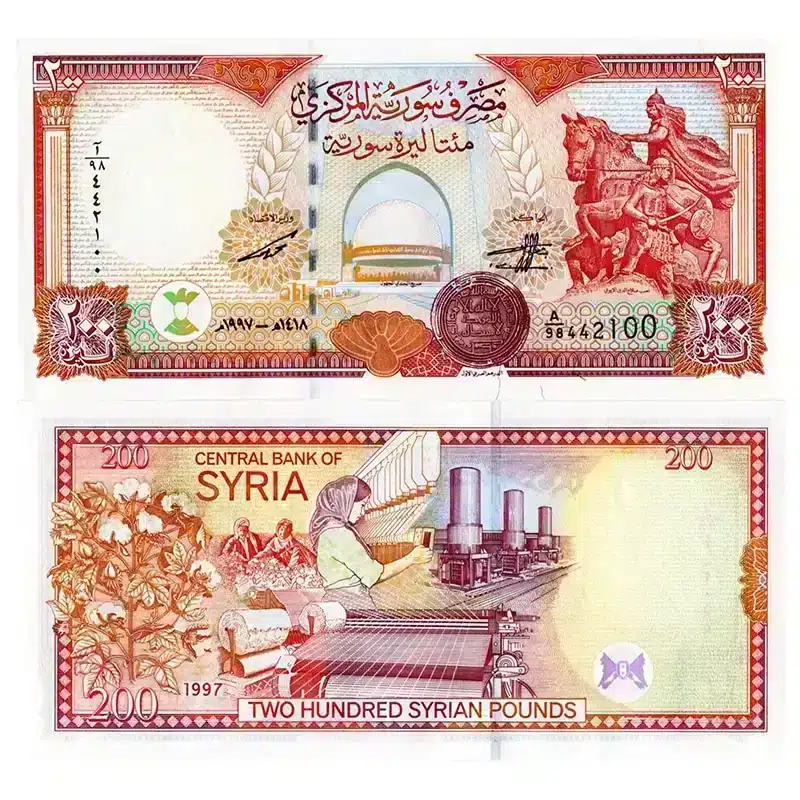
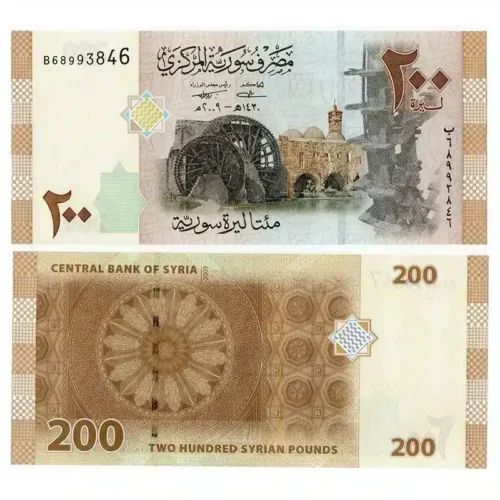
The Syria 200 Pounds 1997 banknote forms the central denomination in the P#107–P#111 sequence and stands apart as the only 1997-dated note in this five-banknote group. Catalogued as Pick P#109, this UNC issue combines military remembrance, the legacy of Saladin, and Syrian agricultural production within one distinctive design.
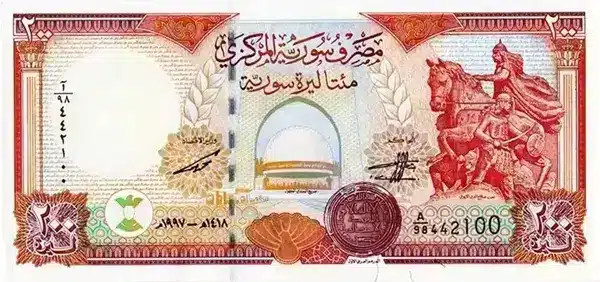
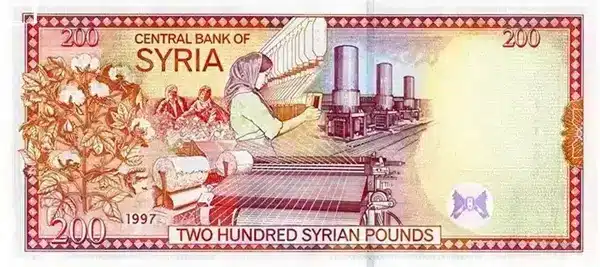
The front presents several historical symbols rather than relying on a single landmark. Most notably, collectors can identify the Tomb of the Unknown Soldier in Damascus and the Monument to Saladin near the Citadel of Damascus. Meanwhile, the reverse changes direction completely, using cotton cultivation and textile-production imagery to represent an important agricultural and industrial activity.
Collector’s Snapshot
Banknote Specifications
Explore additional regional issues in our Middle East banknotes collection.
Front Design | Unknown Soldier & Saladin
Tomb of the Unknown Soldier in Damascus
The front of P#109 features the Tomb of the Unknown Soldier in Damascus. As a memorial subject, it gives this denomination a distinctly different visual identity from the archaeological themes found on the preceding P#108.
Moreover, wheat ears appear within the composition, introducing an agricultural element alongside the commemorative imagery. A representation of a gold dinar coin provides another historical detail and adds further variety to the front design.
Saladin Monument & Damascus Citadel
Another major element is the Monument to Saladin, or Salah al-Din Yusuf, positioned in front of the Citadel of Damascus. Consequently, the design connects one of the best-known figures associated with medieval Middle Eastern history to a recognizable Damascus landmark.
Ancient portico support columns provide an additional architectural element. Therefore, the front combines remembrance, historical leadership, architecture, agriculture, and numismatic imagery within a single composition.
Reverse Design | Cotton Production in Syria
Cotton Plant & Harvest
In contrast to the historical subjects on the front, the reverse concentrates on cotton production. A cotton plant establishes the agricultural theme, while women picking cotton illustrate the harvesting stage.
This change in subject gives P#109 a particularly broad visual narrative. Instead of repeating monuments on both sides, the banknote moves from historical and commemorative imagery to everyday agricultural production.
From Cotton Harvest to Processing
Additional scenes develop the cotton theme beyond harvesting. In particular, the design includes cotton spinning as well as cotton-storage silos.
As a result, the reverse presents several stages connected with the cotton industry rather than depicting only the raw crop. This makes the note especially interesting for collectors who study agriculture, labor, industry, or economic subjects represented on world banknotes.
Printing & Security Features
- Watermark: Head of an Arabian horse visible when viewed against transmitted light.
- Material: Traditional security paper used for this Syrian issue.
- Arabic Front: Arabic inscriptions identify the Central Bank of Syria and the 200 Pounds denomination.
- English Reverse: The reverse carries Central Bank of Syria and Two Hundred Syrian Pounds inscriptions in Latin script.
- Dual Dating: The banknote displays 1418 AH together with 1997 AD.
- Dimensions: Approximately 160 × 75 mm.
Collector Intelligence
A Banknote with Two Different Narratives
One of the strongest features of P#109 is the contrast between its two sides. On the front, the design focuses on remembrance and historical identity through the Unknown Soldier memorial and Saladin. By comparison, the reverse presents cotton cultivation and processing.
Therefore, the banknote works across several thematic collecting categories. Military memorial collectors may focus on the front, while agriculture and industry collectors may find the cotton-production scenes particularly appealing.
Why the 1997 Date Matters in This Sequence
The 200 Pounds note also creates a useful chronological distinction within the five-note P#107–P#111 group. Unlike the surrounding denominations we are organizing in this sequence, P#109 carries the 1997 date.
Consequently, collectors arranging the group by Pick number will encounter a change in date when reaching its central denomination. That distinction makes P#109 easy to identify when reviewing the complete series.
Collection Position | Central Value in the P#107–P#111 Sequence
The Syria 200 Pounds P#109 occupies the middle position in our five-banknote sequence:
P#107 → P#108 → P#109 → P#110 → P#111
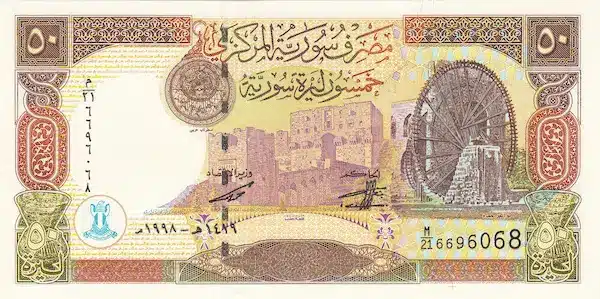
Accordingly, collectors who already have the 50 Pounds P#107 and 100 Pounds P#108 can use this 200 Pounds note to complete the first three consecutive Pick references.
Its position is particularly useful because two denominations precede it and two follow it. Therefore, P#109 functions as the natural center of the complete five-note group.
Collector Checklist
- Pick P#109: Central catalogue reference in the P#107–P#111 sequence.
- 1997 issue: The distinctive 1997-dated denomination within this five-note group.
- Unknown Soldier: Damascus memorial provides the primary commemorative theme.
- Saladin Monument: Adds a recognizable historical figure and Damascus landmark.
- Cotton industry: Reverse illustrates harvesting, spinning, and cotton storage.
- UNC condition: Suitable for clean album presentation and archival storage.
Collector Decision | Why Add P#109?
For a collector assembling the P#107–P#111 sequence, this denomination is essential because it completes the central position between P#108 and P#110. However, its appeal extends beyond sequence building.
Collectors interested in historical personalities receive the Saladin Monument, while military-history themes are represented by the Tomb of the Unknown Soldier. At the same time, agricultural and industrial collectors receive an unusually detailed cotton-production scene on the reverse.
As a result, P#109 works both as an important series component and as an independent thematic banknote.
Archival Storage Recommendations
- Use archival protection: Place the banknote inside an acid-free and PVC-free currency sleeve.
- Preserve the surface: Handle the note only by its edges with clean, dry hands.
- Avoid direct light: Prolonged sunlight can affect printed colors over time.
- Control moisture: Store the banknote in a dry environment with stable conditions.
- Arrange by Pick number: Position P#109 between P#108 and P#110 when building the sequence.
- Protect UNC quality: Finally, never fold, laminate, tape, or write on the banknote.
Collector Takeaway
Syria P#109 combines the Unknown Soldier memorial and Saladin Monument with detailed cotton-production scenes, while its 1997 date and central position give it a distinct role within the P#107–P#111 sequence.
Secure Payment & Worldwide Shipping
- Preparation: Orders are normally prepared within 1–3 business days.
- Protection: The banknote is carefully protected before shipment.
- Serial Notice: Serial number, prefix, and signature may differ from the photographed example.
- Combined Shipping: In addition, combined shipping is available when ordering multiple Syrian or world banknotes.
Continue the P#107–P#111 Syrian Series
Browse our Middle East banknotes collection for additional Syrian and regional paper money.
Within the five-note sequence, collectors can position this 200 Pounds P#109 directly after P#108 and before the higher P#110 and P#111 denominations.
Add this Syria 200 Pounds 1997 P#109 UNC banknote to your collection as the central denomination in the P#107–P#111 Syrian series.
Compare this issue, another edition, or a complete set
Review the closest catalogue variants, collection sets, and denomination options without starting a new search.
Use these options to fill a missing issue or complete more of the series in fewer purchases.
Reviews
There are no reviews yet